
 The Institute for Managing Annual Grasses Invading Natural Ecosystems (IMAGINE), held its 2025 Workshop in Elko, Nevada on June 11 and 12, where challenges in managing annual grasses in northern Nevada were highlighted.
A large part of the vision of IMAGINE is to be pro-active, stay committed and work together in an effort to Defend and Grow the Core. A major point is working on the many challenges that invasive annual grasses such as cheatgrass, medusahead, ventenata and barb goat grass have on western rangelands and that it is important to not only focus on working in areas with little or no annual grass but also working in areas invaded by annual grasses to reverse the current trend. A Core area may be a habitat with very good shrub, perennial grass and forb diversity with little to no invasive annual grasses, or it may be a habitat that has been highly invaded and yet is critical to wintering mule deer or livestock production. Brian Mealor, professor University Wyoming and IMAGINE Director, Claire Visconti, IMAGINE outreach program coordinator, Paul Meiman, State Extension Specialist for Rangeland Livestock/Wildlife Interaction-University Nevada Cooperative Extension, and Matt Glenn, habitat staff specialist-Nevada Department of Wildlife all did an excellent job of updating and informing the attendees on the mission of IMAGINE and the challenges facing northern Nevada when it comes to invasive annual grasses.
Nearly 70% of the Core big sagebrush plant communities have been lost and converted to annual grass dominance, which has had profound negative impacts on wildlife and sustainable grazing resources throughout the western United States (Figure 1).
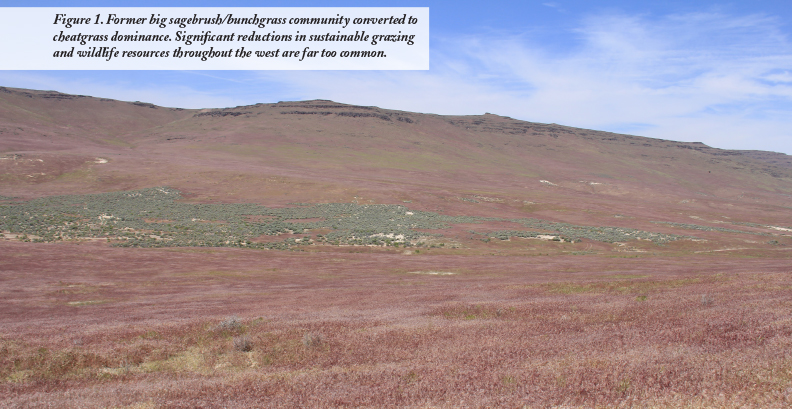
Case in point, mule deer are the only declining big game species in North America, as a browser, many of these former big sagebrush/bunchgrass communities have been converted to cheatgrass dominance which has resulted in an increase in wildfire frequency and further loss of critical browse communities on transitional and winter ranges that are desperately needed for the very survival of mule deer. With all of the challenges that face managers and landowners on western rangelands, it is critically important to communicate what works and what does not work when managing western rangelands to improve sustainable wildlife and grazing resources.
Following a morning session of introductions and background of Defend and Grow the Core, the group made their way to the field to see first-hand on the challenges invasive annual grasses continue to pose.
The first stop was within a U.S. Forest Service boundary where medusahead had invaded the site more than 20 years prior, resulting in a wildfire that also increased the medusahead infestation and was made apparent the dire need for aggressive management to get this exotic and invasive annual grass under control. The site had not received any herbicide applications and the density of medusahead was quite dense and pronounced. This stop was important, as to compare with the next stop which had received medusahead control treatments.
Tom Barnes, 3rd generation rancher, voiced his concerns over the increase in medusahead over the years (at least 30 years) and his concerns of increased wildfire risks and decrease in nutritional value of the affected rangelands.
In 2019, Rejuvra (indaziflam), an effective pre-emergent herbicide on annual grasses, was applied at 5 ounce per acre rate. The site was retreated in 2024 with Rejuvra for continued control of medusahead. Rejuvra provides multiple years (3-5 years) control of invasive annual grasses. The release of residual perennial grasses on the treated habitat was lacking though, which encouraged discussion amongst attendees on the seeding of perennial grasses as a possibility to increase perennial grass densities and diversity.
Tom pointed out that most of the perennial grasses had historically been grazed every spring for years, prior to current management, therefore there were no residual perennial grasses to respond following herbicide applications targeting medusahead. Deep-rooted perennial grasses are the best-known method at suppressing invasive annual grasses for long-term control. Tom also pointed out that “the do nothing approach” only exacerbates the problem and that more needs to be done to curtail the expansion of medusahead and the negative impacts that follow.
George Parker of Morris Ag Air & Sons explained the methodology and challenges of aerially applying herbicides on rangelands, while owner Mike Morris did a field demonstration with a few fly-over passes of adjacent habitat in the presence of the attendees (Figure 2).
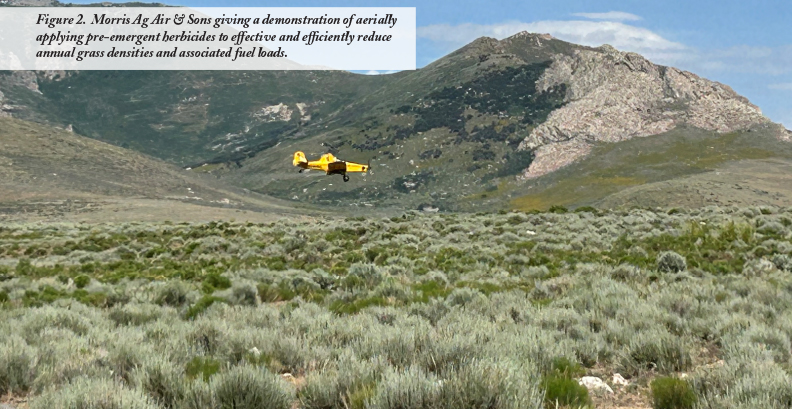
The importance of proper calibration, pattern testing, droplet spectrum, air speed, wind and boom-angle were all discussed.
One lesson learned from this demonstration was that Rejuvra applications require about 30-35% more fly time due to smaller swaths than that of the commonly used pre-emergent herbicide Plateau (imazapic). Applications of Plateau are planned for fall application, fallowed for 1-year and then seeded with desirable species the following fall. Plateau herbicide residue is about 12-15 months control, while Rejuvra is much longer.
A very important part that came from this site visit was the apparent partnership between NDOW and the private landowner, Tom Barnes. Their ability to complement each other and build positive partnerships has already paid dividends and is an excellent model for future collaborations and partnerships.
The second day started out with a site visit to an USDA-ARS, Great Basin Rangelands Research Unit, research exclosure near Izzenhood Basin north of Battle Mountain. The site is a typical xeric Wyoming big sagebrush/bunchgrass community that has experienced numerous wildfires resulting in cheatgrass dominance with other weedy species such as Russian thistle and tumble mustard.
ARS (Agricultural Research Service) is the official research arm of USDA. In 2015, ARS was invited on a field tour with BLM, NDOW, UNR and others to discuss the challenges of rehabilitating cheatgrass-infested rangelands and whether there were any tools to combat this situation, and if so how would you go about it. ARS started their demonstration plots in the fall of 2015 and replicated those plots in 2016 as a reference for land managers and landowners to observe the use of pre-emergent herbicides to successfully control cheatgrass and the importance of proper seed mixes and seeding rates to be successful in rehabilitating/restoring perennial grasses in highly disturbed xeric communities.
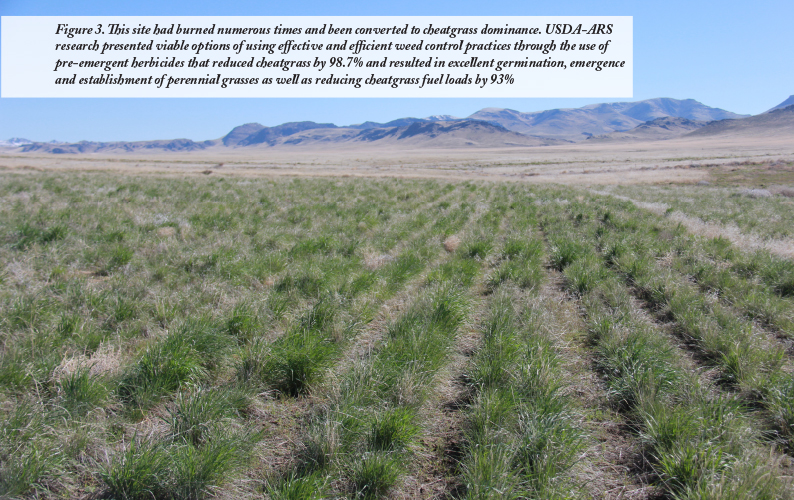
Charlie Clements, Rangeland Scientist, and Dan Harmon, Agricultural Research Technician, described to the attendees the application of the pre-emergent herbicide, Landmark (sulfometuron-methyl chlorosulfuron) at 1.75 ounce per acre rate that effectively reduced cheatgrass densities by 98.7%. They pointed out that in the process of applying these demonstration plots that Landmark was pulled from the market, therefore they changed their preference of herbicide to Plateau at a 6 ounce per acre rate.
In these plots they seeded an Introduced Mix, Siberian and crested wheatgrass with ‘Immigrant’ and ‘Snowstorm’ forage kochia, Native Mix, ‘Anatone’ bluebunch wheatgrass, Sandberg bluegrass and Sherman big bluegrass, western yarrow and Wyoming big sagebrush, and Native-Introduced Mix, Bluebunch wheatgrass, Siberian wheatgrass, Wyoming big sagebrush, western yarrow and ‘Snowstorm’ forage kochia.
Charlie and Dan pointed out the importance of using a Native-Introduced seed mix to hedge your bets during sub-par precipitation years. Demonstration plots between the years revealed that in the 2015-2016 plots (sprayed in 2015 and seeded 2016), the site received a little more than 13 “ of precipitation, 2.4” by late November, and that the majority of seeds of seeded species had germinated and emerged by late November and they believe this early emergence increases root development and is advantageous come late spring/early summer during hot and dry conditions to increase the plants ability to uptake limited available moisture from the soil. In the 2016-2017 plot (sprayed in 2016 and seeded fall 2017) the site received 7.9” with only 0.4” by late November and no sign of emergence of seeded species. This level of precipitation is more common for this site, and under these precipitation conditions native species performed far less with Sandberg bluegrass being the only native species to consistently establish. Therefore, using the Native/Introduced seed mix allowed for species like Siberian wheatgrass to maintain good densities and provide active cheatgrass suppression.
These successful seedings increased perennial grass densities from less than 50 per acre to more than 100,000 per acre and decreased cheatgrass fuel loads by more than 93% (Figure 3). ARS also pointed out the importance of productive partnerships and communications to improve success rates of rangeland restoration programs.
The group then traveled to the 2017 Roosters Comb Fire that burned 220,000 acres. Tyson Grip, BLM Nevada State Fire Lead, explained to the group that they only have 14 days to put a plan together and during this particular year there were numerous large fires which all need attention, but the reality is that there are limited seed resources and limited time to apply and contract restoration projects. Matt Glenn and Caleb McAdoo, Nevada Department of Wildlife, Deputy of Operations, also pointed out that during this significant fire year, critical mule deer winter range habitat had also burned and that the Department and BLM shifted resources to address the concerns of added loss of critical mule deer winter range habitat. These are the decisions that land managers face when trying to achieve stated goals and objectives with limited resources. The habitat that was seeded on the Roosters Comb Fire was a resounding success as the deep-rooted perennial grasses in the seed mix performed very well and continue to successfully suppress cheatgrass and reduce the threat of wildfires. The Nevada Department of Wildlife and BLM have developed a highly successful partnership that is a model for others to follow and truly complement each other and improves the level of success on post-fire restoration that is desperately needed to improve wildlife and grazing resources.
The group then traveled to the Dunphy Hills/Boulder Valley area where Chris Jasmine, Manager of Biodiversity and Rangelands for Nevada Gold Mines, and James Stuart, Ranch Manager for Nevada Gold Mines, discussed the use of targeted grazing to reduce cheatgrass fuel loads (Figure 4). The example that they showed us was an 18 mile long strip about 300 years wide aided with fencing, water and supplements that resulted in a reduction in cheatgrass continuity, height and overall fuel loads that helped firefighters knock back an advancing wildfire and prevented further loss of habitat. They also pointed out the importance of the use of a specific type of livestock to a specific time and duration of intensity to reach a stated outcome. This all has to factor in the overall management of cattle as the livestock operation needs to produce healthy animals and take into consideration the animal’s ability to travel for water, etc., while also maintaining health.
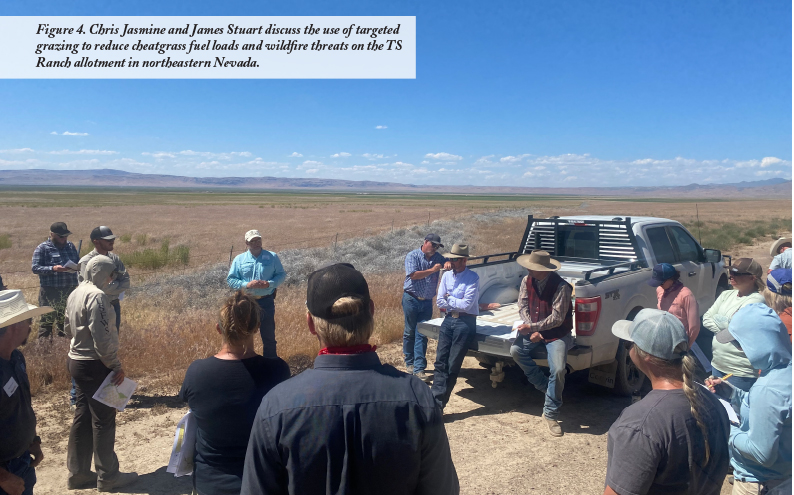
James pointed out that during dormant season grazing, protein supplements are used to maintain the health of the stock. The use of cattle to target cheatgrass has shown positive results in reducing carry-over fuel as well as targeting cheatgrass in the spring prior to the wildfire season. Tyson Gripp also pointed out his experience with targeted grazing and how fire personnel have commented on the decrease in flame length and fuel continuity within targeted grazing areas.
The IMAGINE group is doing a very good job of touring on-the-ground experiences when managing habitats invaded by annual grasses. The focus on seeing firsthand what works and what does not work when it comes to managing invasive annual grasses will provide land managers and property owners with the necessary information to make informed decisions that will ultimately benefit rangelands and reduce the negative impacts associated with invasive annual grasses.
Improved partnerships and collaborations among the numerous federal, state and local governments as well as private landowners will be critical in implementing successful rangeland management projects, which was on display during the IMAGINE 2025 Workshop.
By Charlie D. Clements and Dan Harmon